
Six Ways to Tackle Serious Debt


When the debt gets serious, the hardest part usually isn't the math - it's not knowing which door to try first.
If you're reading this, there's a good chance the balances have been sitting in the back of your mind for a while. Maybe it's a few credit cards that keep creeping up. Maybe it's a line of credit, a car loan, a tax bill, and a collection letter or two. Maybe you're paying every month and the total barely moves.
First, a reassurance: this is far more common than anyone admits at dinner parties, and it says nothing about your character. Life happens - a job change, a new baby, a rate hike, a stretch of illness, a renovation that ran long. The question isn't how you got here. It's what to do next.
The good news is that there isn't just one way out. There are several, and each one fits a different situation. Here are six of the most common routes Canadians take, from the lightest touch to the most structured, so you can see where you might fit.
1. A do-it-yourself payoff plan
If your debt is serious but still manageable - you're current on payments and have some room in your budget - a focused plan on your own can work. The two best-known methods are simple. With the avalanche method, you put every spare dollar toward the card with the highest interest rate while paying the minimum on the rest, which saves the most in interest. With the snowball method, you knock out the smallest balance first for a quick win, then roll that payment into the next one.
Neither is magic. They both need room in your budget and a lot of steady willpower. But if the numbers work, this is the route with no paperwork and no new accounts.
2. A debt consolidation loan
Consolidation means rolling several debts into one, ideally at a lower interest rate and a single monthly payment. It can make life simpler and cut the interest you pay - but only if you qualify for a rate that's actually better than what you have now, and only if the old cards stay quiet afterwards.
That second part is where it goes wrong for a lot of people. If the cards are paid off with the loan and then slowly run back up, you end up with the loan and the new balances. Consolidation fixes the structure, not the habit that created the pile, so it works best when the spending side is under control.

3. A debt management plan through credit counselling
A debt management plan, or DMP, is arranged through a non-profit credit counselling agency. A counsellor looks at your budget, then contacts your creditors to ask for reduced or frozen interest. You make one monthly payment to the agency, and they distribute it to your creditors.
The big advantage is that you typically repay what you borrowed in full, just with the interest pressure off. The trade-off is that it's a commitment: the accounts included are usually closed, and you'll need to keep up the payment month after month. It suits people with steady income who can repay what they owe but need the interest out of the way.
4. Using the equity in your home
If you own a home, the equity you've built up can sometimes be used to replace high-interest debt with lower-interest borrowing - through a refinance, a second mortgage, or a home equity line of credit. Because the borrowing is secured by your home, the rates are usually well below credit card rates, and the payments can be much easier to carry.
It's a powerful tool, but it deserves a clear head. You're turning unsecured debt into debt attached to your house, so it only makes sense if your income can support the new payment comfortably and the underlying habits are sorted. Qualifying is also not a given - lenders look closely at income, credit, and the property. We've written a full guide on this one if you'd like the details.
5. A consumer proposal
A consumer proposal is a formal, legally binding process in Canada, filed through a Licensed Insolvency Trustee. The trustee works out an offer to your creditors - typically less than the full amount owed, paid over a set term. If the creditors accept, interest on the included debts stops, and you make a single monthly payment under the agreement.
It can offer real breathing room, and it carries legal protection once it's filed. The trade-offs are just as real: it's a formal insolvency process, it is noted on your credit report for as long as it runs and for a period afterwards, and it can affect things like borrowing. For some people the structure and certainty are exactly what they need.
6. Debt settlement
Debt settlement is an approach where creditors may agree to accept less than the full balance as payment in full. It's usually considered by people who are behind or struggling to keep up, have more debt than their income can realistically repay, and want to avoid a formal insolvency filing.
Like every option on this list, it has trade-offs. Accounts that are being settled are typically reported as such, so your credit will take a hit in the short term. Outcomes vary from one situation to the next, and nothing is guaranteed. That's why it's worth talking it through with someone who explains both sides honestly before you decide anything.
What about bankruptcy?
You may have noticed it isn't on the list. Bankruptcy is a legitimate, legal option in Canada, and for some people it's genuinely the right answer. It's also the most far-reaching, with the biggest impact on your credit and your assets, which is why it tends to be the last door rather than the first. It's worth knowing it exists, and worth exploring the other routes before deciding it's your only one.
So how do you choose?
There's no single best option - only the one that fits your income, your balances, your home situation, and what you're hoping to protect. A few questions tend to narrow it quickly. Can you comfortably repay everything you owe if the interest were lower? Are you current, or already behind? Do you own a home with equity? How much does a formal filing matter to you?
If you can repay in full with a lower rate, consolidation, a DMP, or home equity may fit. If the total is more than your income can realistically clear, a consumer proposal or debt settlement is worth a closer look. And if you're not sure which side of that line you're on, that's the most common answer of all - and exactly what a conversation is for.

The short version

Serious debt feels like a dead end when you're standing in the middle of it. It usually isn't. It's a puzzle with several workable answers, and the hardest piece is simply seeing them laid out side by side. Now you have.
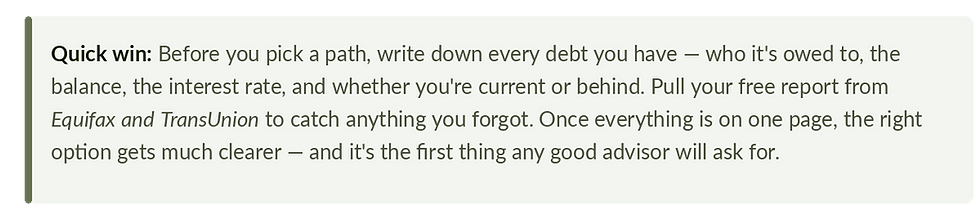
The next step doesn't have to be dramatic. It can be as small as writing the list, checking your reports, or having one honest conversation with someone who isn't going to judge you for any of it.
Not sure which path fits you?
We'll walk through your situation with you - the numbers, the options, and the honest pros and cons of each. No judgment, no jargon, and no pressure to decide anything on the call.
Programs, eligibility, and outcomes vary by situation and can change over time. Your circumstances are unique - for guidance specific to you, reach out for a free, no-pressure conversation.
This article is general information, not financial, legal or credit advice.


Comments