
Debt Consolidation: What It Really Does


Consolidation gets talked about like it erases what you owe. It doesn't. It moves it - and whether that helps comes down to two things almost nobody mentions.
If you're carrying balances on a few cards and a line of credit, you have probably been told to consolidate. It's the advice that comes up first, from friends, from your bank, from every ad that finds you after you Google your situation at midnight. And it isn't bad advice. For a lot of Canadians, rolling several balances into one loan is genuinely the right move.
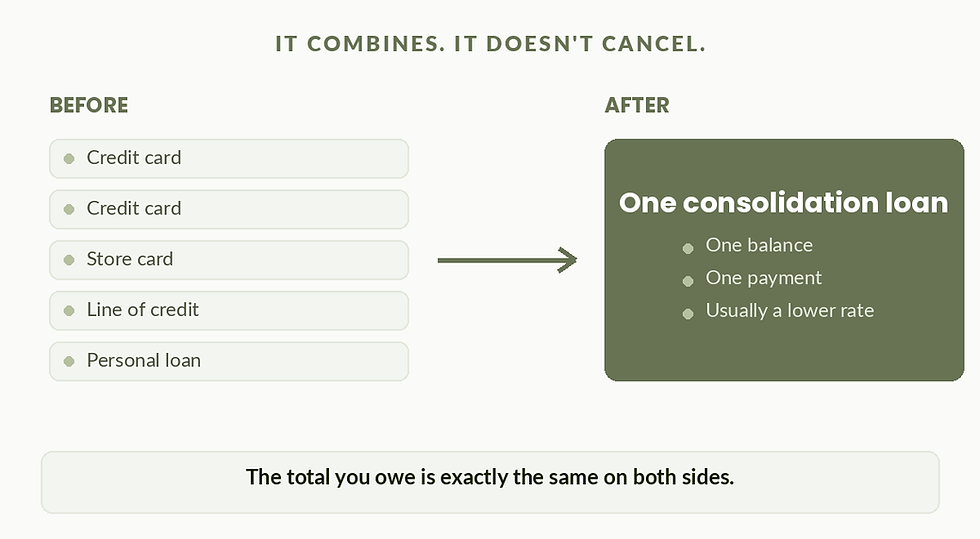
But it gets described in a way that sets people up for disappointment. Consolidation doesn't reduce what you owe. The total is the same the morning after as it was the night before. What changes is the shape of it: one balance instead of five, one payment instead of five, and usually a lower interest rate. That's worth having. It's just a different thing from the debt getting smaller, and the gap between those two ideas is where a lot of people get hurt.
What consolidation actually is
A consolidation loan is a new loan large enough to pay off your existing balances. The lender either sends the money to your creditors directly or deposits it to you to do it yourself. Your cards and lines go to zero, and you're left with one loan, one interest rate, and one due date.
The appeal is real, and it's not only about the rate. Juggling five due dates across five statements is how good intentions turn into a missed payment. One payment on one date is easier to manage, and payment history is the single biggest factor in your Canadian credit score, so simply not missing things has value on its own.
The rate matters too. When a high-interest balance moves to a lower-rate loan, more of every payment lands on the principal instead of the interest. That's the mechanical reason consolidation can work: the same monthly dollar does more.
Which is exactly why the term deserves a hard look.
The first quiet decider: the term
When a lender quotes you a consolidation loan, the number they lead with is the monthly payment. It's the number that feels like the answer, because it's the one that has to fit into your life. And a lender can make that number look almost any way you want, simply by stretching the term.
Here's the trade in plain terms. A longer term means a smaller payment and more total interest paid over the life of the loan. A shorter term means a bigger payment and less total interest. Neither is right or wrong - but a smaller payment is not automatically a better deal, and it's very easy to walk out relieved about the monthly figure without ever asking what the whole thing costs.
So ask. What will I have paid in total by the time this is done? Any legitimate lender can tell you, and comparing two offers on that number rather than the monthly one changes which offer wins more often than you'd think.

The second quiet decider: what happens to the cards
This is the one that actually decides it, and it has nothing to do with interest rates.
The day the consolidation funds land, your cards sit at zero - with their full limits still available. That's a strange and slightly dangerous moment. It feels like progress, because it is progress on paper, but nothing about the household budget has changed. If the money was tight enough to build those balances in the first place, it's still tight, and the cards are now empty and waiting.
The most common way this goes sideways in Canada isn't a bad rate or a predatory lender. It's the cards quietly refilling over the following year, until you're carrying the consolidation loan and the balances all over again - with a larger total payment than you started with, and one fewer tool left to reach for.
That's not a character flaw and it isn't carelessness. It's what happens when the debt gets reorganized but the reason it built up doesn't get addressed. If your income covers your life with nothing left over, consolidation buys breathing room, not a solution. Worth being honest with yourself about which one you actually need before you sign.

What it does to your credit score
Consolidating touches your credit report in a few predictable ways, and knowing them in advance keeps you from misreading a normal dip as a mistake.
A hard inquiry, and a short dip
Applying creates a hard inquiry, and a new account lowers the average age of your credit. Both nudge your score down a little. This is normal and it's temporary - on-time payments generally earn it back and then some.
Your utilization usually improves
Paying revolving balances down to zero drops your credit utilization, which is the second-biggest factor in your score. That's often the largest single benefit, and it can show up within a statement cycle or two.
Closing the old cards can backfire
It feels responsible, but closing cards shrinks your total available credit, which pushes your utilization ratio back up. Cutting up the card and leaving the account open is usually kinder to your score than closing it - though if you know a live card is a genuine risk for you, protecting your budget matters more than protecting a number.
The loan reports as instalment credit
A mix of credit types is mildly helpful, and a steadily shrinking instalment loan with a clean payment history is a good look on a Canadian credit report over time.
If a lender says no
Plenty of people get turned down for a consolidation loan, and it usually happens at the worst possible moment - when the balances are high enough that the score has already taken a hit, which is precisely what makes the lender nervous. It feels like a door closing on the only option there was.
It isn't. A decline is information, not a verdict. What it usually means is that the numbers don't support borrowing your way out at a rate that would help, and that's genuinely useful to know before you spend three more months trying.
The routes that open up from there are different in kind, not just in name:
A debt management plan - through a non-profit credit counselling agency, where interest is often reduced and you repay the balances over a set period.
Debt settlement - where unsecured balances are negotiated down and resolved
for less than the full amount - a private arrangement, with no filing.
A consumer proposal - a formal insolvency process administered by a Licensed
Insolvency Trustee that binds all your creditors at once.
Home equity - if you own your home - which can fund a consolidation, or fund
settlements, and often gives homeowners more room than they realize.
That last one is worth pausing on, because it's where the two ideas meet. A homeowner considering consolidation is usually thinking about borrowing enough to pay every balance in full. But unsecured balances can often be negotiated down first, and a lower settled figure needs less borrowing to clear. Same equity, considerably less debt moved onto the house.
So is consolidation a good idea?
It's a good idea when three things are true at once: the new rate is meaningfully lower than what you're paying now, the term is short enough that the total cost actually improves, and you have enough monthly room that the cards won't need to refill. When those line up, consolidation is one of the cleanest moves available - simpler, cheaper, and easier to stay on top of.
When they don't, it tends to postpone the problem rather than solve it. And postponing costs something: another year of interest, another hit when the balances come back, and one fewer option left. There's no shame in either answer. The only real mistake is not checking which one you're in.
The short version

Consolidation is a tool, not a cure. Used at the right moment it makes a heavy situation manageable. Used at the wrong one it hides the weight for a while and hands it back heavier. The difference is entirely in the numbers - and those are knowable before you sign anything.
Not sure if consolidating is the right move?
We'll walk through your numbers with you in plain language - what you owe, what a consolidation would really cost you, and which other routes are realistically open. No judgment, no pressure. If a consolidation loan is your best option, we'll tell you that too.
Lending criteria, interest rates, and loan terms vary by lender and province, and consumer proposals can only be administered by a Licensed Insolvency Trustee. Your situation is unique - for guidance specific to you, reach out for a free, no-pressure conversation.
This article is general information, not financial, credit, or legal advice.


Comments